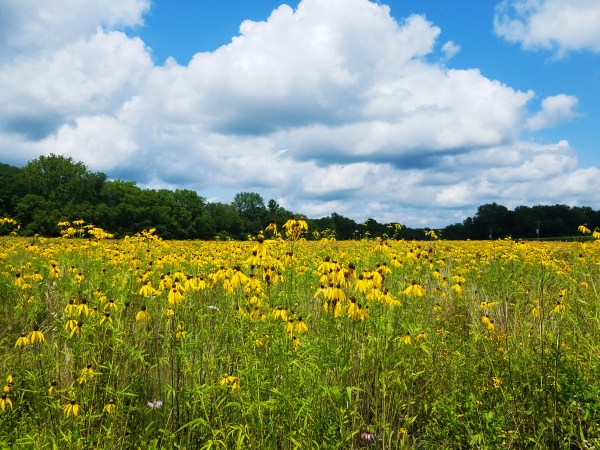
Starting in June, the Perry Farm is yellow. Yellow with coreopsis. Yellow with black-eyed Susan and yellow coneflower. Yellow with partridge pea and six kinds of goldenrod.
There is so much yellow that I have to go looking for the outliers. That patch of red? Royal catchfly and cardinal flowers. That clump of orange? Butterfly milkweed. That swathe of lavender is the last of the wild bergamot. And that flash of blue is from the bellflowers that grow on the wood’s edge.
But most of the other native plants are yellow. Why is that?
We remember the basics from high school biology class. Flowers are yellow because of the carotenoid in their cells. And yellow reflects light and is easy to see in a sea of green plants. But it’s more complicated than this. The insects the flowers are co-dependent on see color differently than we do: To them, yellow looks white, with a red bullseye in its center. Over eons, plants figured this out.
I imagine the conversation went something like this:
“I’m not particular about what color I wear. But you clearly think I look good in yellow—why else would you keep coming back year after year? So yellow it is.“
While there is no denying that the Perry Farm is yellow, I hate to make a generalization based on such a small sample size. So I did some research. There are about 178 plants native to Illinois. Much to my surprise, the largest percentage (35%) are white. Yellow comes in second at 20%. And number three? Purple.
So let’s switch that song lyric up: “It was all white, yellow, or purple.”
 M. H. Perry
Leave a comment